Active Recall Studying: The Ultimate Guide for 2026
Updated for 2026
Suppose that two students are reading the same chapter and taking the same test. One points out all key lines and reads the chapter twice. The second one reads the book once and attempts to write out all the information they remember, before going back to read what they failed to remember. A second student, this time testing himself rather than re-reading, had significantly more information a week later, according to a landmark study published in the Journal Science. This is the whole concept of active recall studying, and one of the most well-supported learning techniques in cognitive psychology.
In this guide, you’ll learn what active recall studying really is, the research supporting it, how it compares to just re-reading your notes, an extensive list of active recall studying techniques you can use right now, the best active recall studying apps for 2026, free active recall studying website tools that don’t require downloading, and active recall studying tips by subject and learning style. It’s supposed to be the most comprehensive resource on the subject at this time, so bookmark it and come back for more when exam time strikes again.
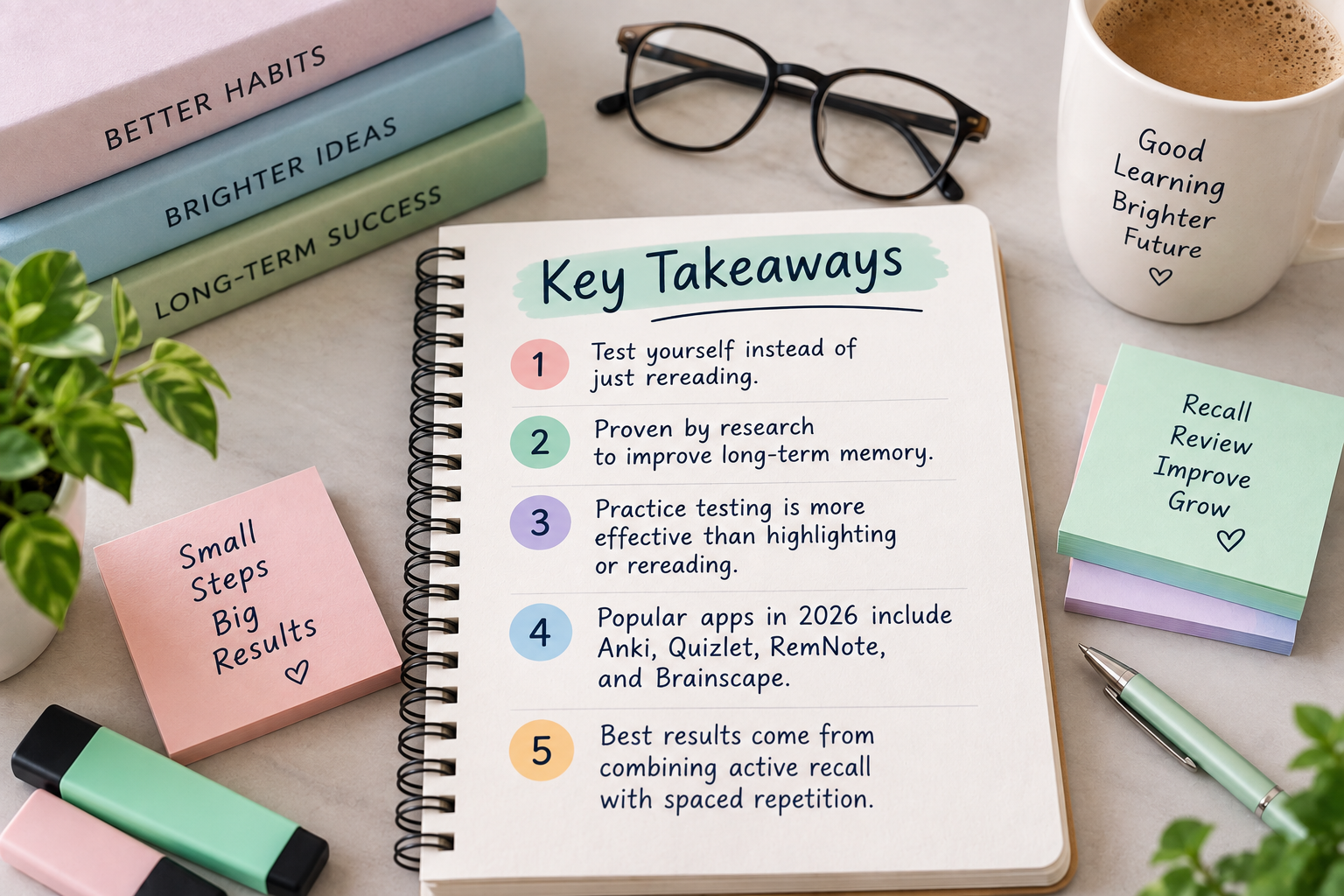
Key Takeaways
- Active recall involves test-taking by recalling the information from memory rather than passively re-reading or highlighting the material.
- Research in a groundbreaking study in Science published in the Science magazine concluded that students doing retrieval were found to be better in one test, one week after their practice compared to students doing concept mapping.
- Practice testing was one of the two techniques that were rated high utility in a major review of ten common study techniques (rereading and highlighting were rated as low utility).
- In 2026, some of the most popular active recall apps are Anki, Quizlet, RemNote, and Brainscape, all of which have different learning styles.
- To achieve the best results, active recall is used with spaced repetition, which involves reviewing material at progressively longer intervals.

What is Active Recall Studying
Active recall studying refers to a method of studying that involves using self-testing (practice recall) instead of rereading, highlighting or listening to the material. The testing effect is the idea that one strengthens memory for the material being learned by engaging in the effort to pull the material out of his or her own memory, rather than recognizing it on a page. This is one of the most robust phenomena in learning science.
Active recall studying is not a process of recognition. It is much easier to recognize a fact from a multiple choice test than to “invent” it from scratch, without any context. The distinction is important as students can get a false sense of security about their knowledge of material by reading it repeatedly until they sit for an exam and find they cannot reproduce it without the source text in front of them.
What Is The Difference Between Active Recall And Spaced Repetition?
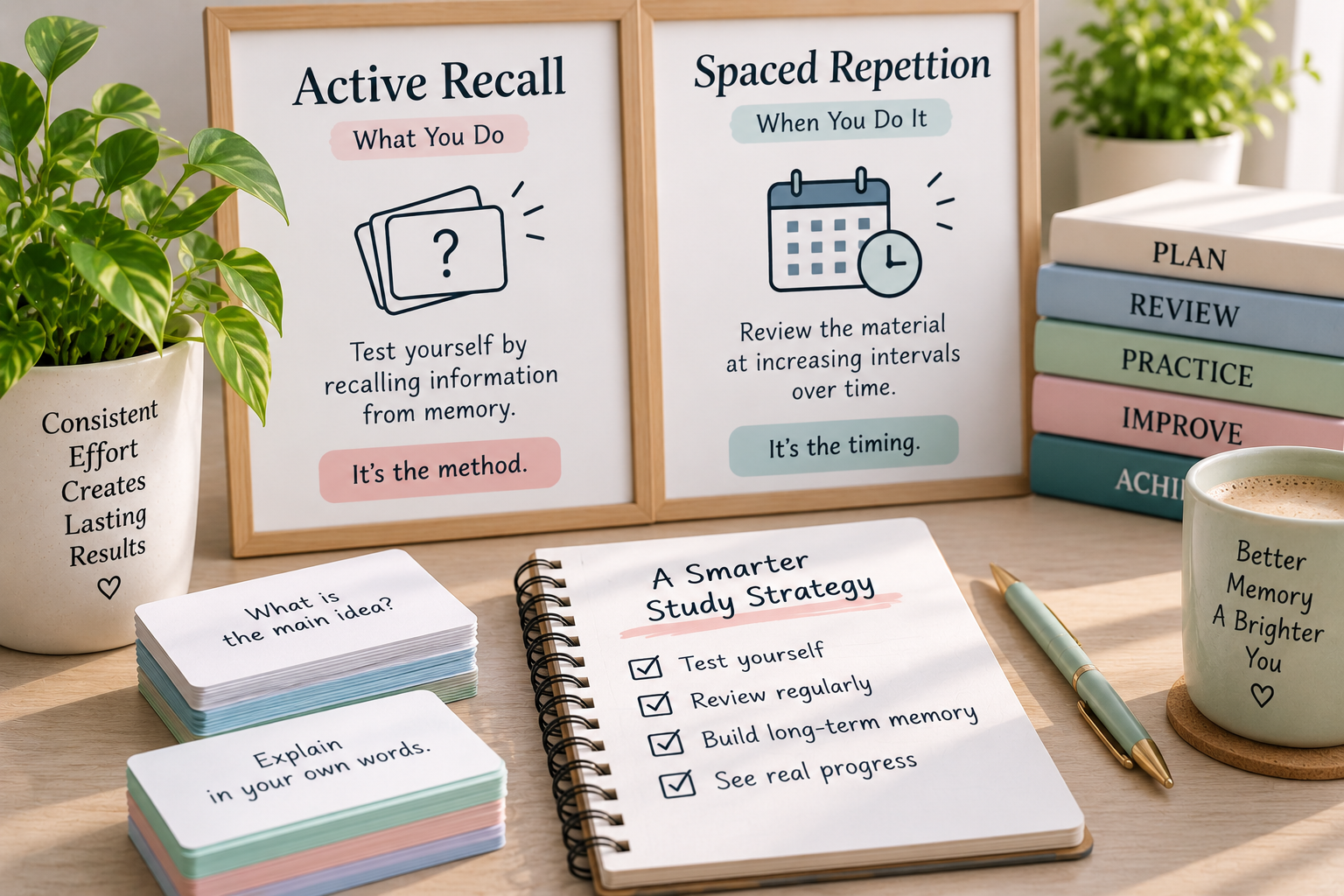
The technique is testing yourself (active recall) and the timing is reviewing the material at increasing intervals (spaced repetition). They’re often mixed up because they’re typically coupled together – most flashcard software pairs both together by quizzing you and then schedules its next review based on the result of your answers – but they’re actually two separate concepts that lend themselves well to being used together.
The Science Behind Active Recall Studying
Active recall studying is not new, it has a hundred years of research under its belt dating back to the early retrieval experiments in the 1910s, and although it has not been a common activity in classrooms until the 2000s, it is now everywhere. In a 2011 study published by Jeffrey Karpicke and Janell Blunt in the journal Science, college students who practiced free recall of an educational text performed better on tests administered one week later than students who studied the same texts with elaborative concept mapping.
That’s significant because concept mapping has been deemed by many to be an “elaborate, hard work” study method, and most of the students in the study did not anticipate that concept mapping would be effective. Even though the final test itself involved creating a concept map, in which the benefit of retrieval practice did not depend on the format in which it was retrieved, active recall was the winner anyway.
Does it matter if there’s more than one study behind Active Recall?
While it’s true that there’s one study that supports active recall, it’s a vast body of research — not just one. According to a 2013 Psychological Science in the Public Interest review of 10 learning strategies, practice testing – the academic term for active recall – was one of only two strategies that were highly versatile for a large number of students, subjects and contexts.
Why does Active Recall outperform Rereading?
Active recall is more effective than rereading because when you recall information you strengthen the pathway to the memory of that information, but when you reread you strengthen the familiarity with the text itself. Research from Purdue University’s Learning Lab suggests retrieval practice doesn’t just require you to access the information over and over, it seems it engages retrieval specific mechanisms that cannot be replaced by rereading.
The best way to learn what a topic looks like is to reread it; the best way to learn what a topic feels like to produce from nothing is to read it.
The comparison of Active Recall and Reading Effectiveness Study.
The most widely referenced study in this column comparing active recall to reading is the 2011 Karpicke and Blunt study mentioned above and is the most unequivocal head-to-head comparison you’ll find. That study compared students who read a text once, then free recalled twice, to those who reread the same text several times, without returning to the source text, and students who made greater scores on the free recall test.
The specifics of the particular research found in a clear manner.
| Study Method | Immediate Test Performance | One Week Delayed Test |
| Reading once | Lower baseline | Weakest long term retention |
| Rereading multiple times | Feels more confident | Rapidly fades like single reading |
| Using concept mapping during reading. | Strong immediate engagement | Underperformed retrieval practice |
| Active recall (free recall) | Somewhat less confidence or similar feeling of confidence | Strongest long term retention |
In almost all active recall vs reading effectiveness studies done on this topic, both the pattern and the results are the same: when you reread something, you feel like you are doing more to get it, because you feel familiar with it, whereas when you use active recall, you feel like you are doing more to get it, because you don’t feel familiar with it. Rather the discomfort is not indicative of a failure of the technique, it’s evidence that it is working, as Cognitive Psychologists refer to this kind of productive difficulty as a desirable difficulty.
The Active Recall Study Skills You Can Use Today
A well-organized study guide can also make active recall easier by turning key information into questions you can test yourself on. All the best studying techniques for active recall have this in common. They require you to retrieve information, not just read it over. These are the techniques you want to add to your arsenal.
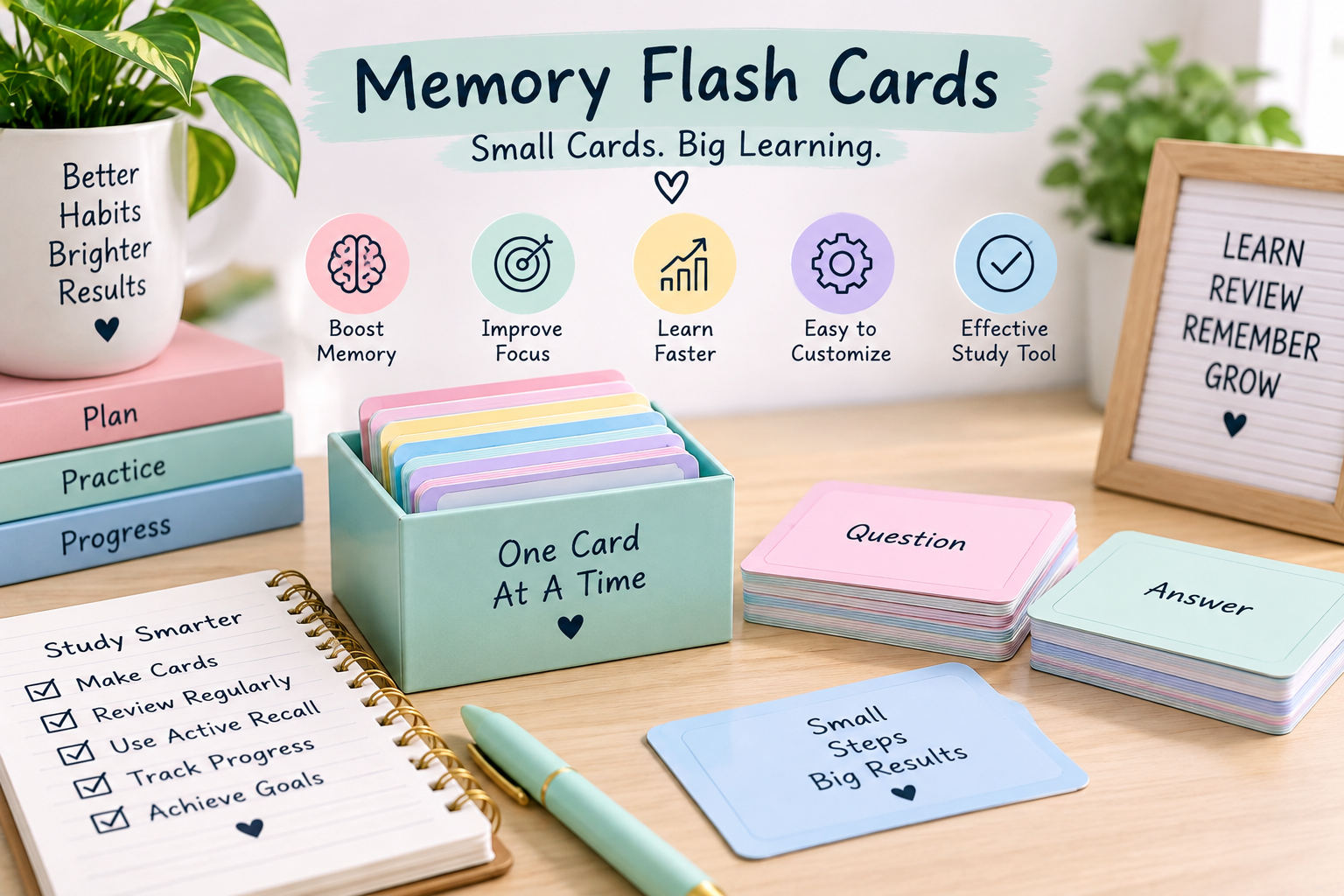
- Real card with a check mark system that can be flipped. Write the question on one side of the paper and the answer on the other, then flip it over, read the answer out loud, then compare with the other side of the paper. It is important that the student speaks it, as thinking it silently is much easier to deceive himself than saying it aloud.
- Use past tests and test questions written by yourself. If you can get past papers, do so, otherwise make your own questions based on your notes and sit them at the end of class, as close to exam conditions as possible including time limit.
- The blurting method. Shut all the books and notepads, grab a blank piece of paper, and start jotting down all the information you can about a subject without any assistance whatsoever. Review your notes afterward and compare what you wrote with your actual notes, to identify any gaps.
- Teaching others about it, also known as the Feynman technique. Discuss the topic with a friend, family member, or even an empty room, in terms that are easy for a beginner to understand. Every time you become stilted or resort to jargon is a place you do not know in your understanding.
- Summarizing from memory, not looking at the source. Read one section, close it, then summarize it from memory only, and then compare the summary to the original to make sure it is correct.
- Work through questions within your notes. While taking notes during a lecture, make a space or write down a question rather than an answer, and later review and quiz yourself on your blank spaces with just your notes as the cue.
How many times should you use active recall studying techniques?
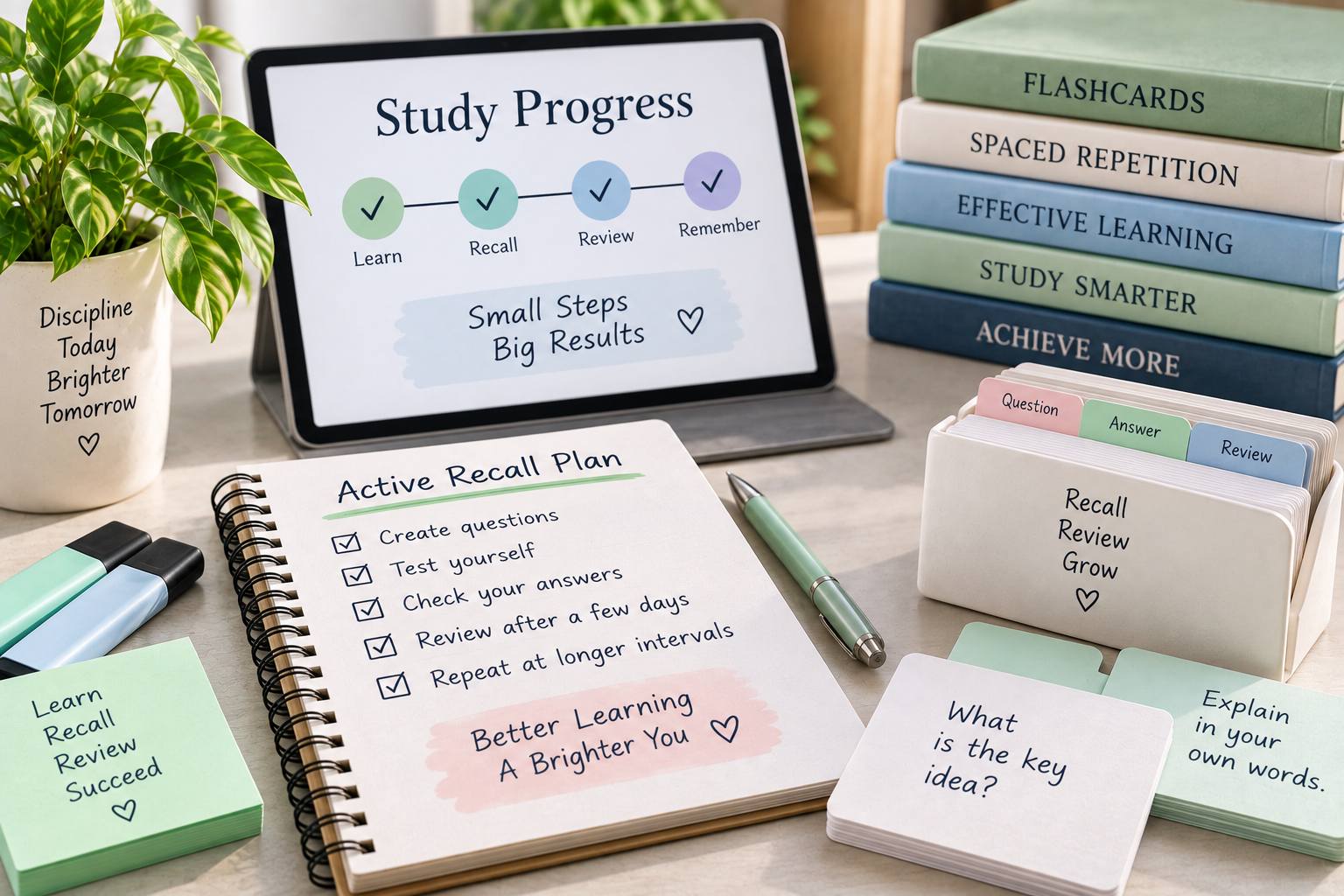
Active recall studying techniques are better suited in short, frequent sessions as opposed to one long session prior to an exam. The research on the spacing effect complements active recall and indicates that a short ten to fifteen minutes review every day, plus spaced review of material every few days, is more effective than one big study session per day.
Active recall can be a trick for helping students remember information. Active recall is a strategy to aid student learning.
A good recall application automates the two most difficult aspects of this technique: creating good questions and the timing for the next time to see the questions. Here’s a straightforward list of the options students actually use in 2026.
The Best Active Recall App Options For 2026
An active recall app does the two most difficult aspects of this method: create good questions and remind you when to see them again. Here’s a sincere list of the dominant choices made by students in 2026.
| Apps | Best For | Free Tier | Main Limitation |
| Anki | Serious self directed learners, especially medical students | Yes, 100% free on desktop and Android | A steep learning curve and manual creation of cards. |
| Quizlet | For beginners and those who need a quick pre-made deck! | Yes, but restrictions apply to some study modes | Less spaced repetition scheduling than Anki. |
| RemNote | Students who would like notes and flashcards in a single tool. | Yes, of course there will be limits on the number of cards. | Cards remain within RemNote’s own system. |
| Brainscape | Confidence based review, Certification exams | Yes, limited decks | Less library size than Quizlet for general courses |
Is Anki The Best Active Recall App?
The best reason for this is that Anki’s scheduling algorithm and total customization are widely regarded as the most powerful active recall app that can be used by students willing to invest in getting to know it. It’s free, open source, and widely used in medical schools, especially for studying for board exams, but the downside of the game is that if you want to use it, every single card has to be made by hand, unless you combine it with a separate card generator tool.
Which Active Recall App is the best choice for beginners?
Quizlet has a sleek user interface and a vast library of user-made sets for standard text books and courses, so it’s generally the most easy to use active recall app for novices. The drawback is that while it has study modes, they are not as spaced as software designed for long term learning, such as Anki, so serious learners can work past them and onto Anki when they need the fine grain spacing control.
Active Recall Website Tools You Can Use Without Downloading Anything
If you are learning on shared computers or school computers where software installation is not a possibility or if you prefer to work completely within the browser, an active recall website tool can be helpful. Quizlet, Anki and Brainscape can all be used as an active recall website without any downloads required, and all three will sync your progress to an account and allow you to continue after you log in from any device.
The greatest benefit to an active recall website compared to a downloaded app is the ability to open a browser tab on a library computer, school Chromebook, or friend’s laptop then continue exactly where you left off. The trade off is that with browser based tools, you will need a steady internet connection, while with a desktop app such as Anki, you can use your entire deck without requiring an internet connection.
Active Recall Tips for Various Subject
Here are some tips for Active Recall for various subjects below.
These tips for active recall are a little different depending on the topic being learned, as an active recall question to a math class with a heavy emphasis on formulas will be different from an active recall question to a history class with a heavy emphasis on concepts.
- Maths and formula related topics. Don’t only remember the formula, remember when to use it. Practice questions that involve a real-life situation and require you to remember and use the right formula, rather than just recite it.
- History and literature. Construct questions that ask students to explain cause and effect instead of to recall a single date, because essay examinations in these disciplines typically involve asking students to address the question of cause and effect and not merely to remember a single date.
- Science with heavy vocabulary. Quiz yourself on definitions in both directions, term to definition and definition to term, since exams often phrase questions using the definition rather than the exact vocabulary word you studied.
- Language learning. Combine active recall with spaced repetition specifically, since vocabulary retention research consistently shows spacing produces the largest gains for exactly this kind of material.
How does Active Recall Studying Compare to Other Study Methods?
There are other methods of studying that students are used to, and it is worthwhile to compare how it compares to those in order to see their effectiveness.
| Method | What It Involves | Research Rated Utility | Weak Point |
| Active Recall | Remembering the content for the test. | High | Spaced repetition. |
| Rereading | To read the same text again | Low | Should not be used as a review strategy, but as a first pass only. |
| Highlighting | Highlighting important text in a text while reading. | Low | Should be followed up with ACTIVE recall, NOT just read. |
| Summarizing | Using shorthand to record text. | Low to moderate | Becomes more effective post. |
| Concept Mapping | Drawing visual nodes and link diagrams. | Moderate | Faced difficulty in direct recall compared to peers. |
Making Errors Quietly Decreases The Effects Of Active Recall
- Looking at the answer without considering it for a while. Allow yourself time to grapple with and struggle with the memory, and real time to look at it before you look at it again, because the struggle is what makes the memory stick in your mind, even when it doesn’t stick.
- Reviewing material that is not new to you. Easy cards are fun to retrieve, and a bonus to retrieve the same card repeatedly when you miss it.
- Considering one review session to be sufficient. Although active recall (without spaced repetition) helps, the long term retention is due to multiple reviews of the material at increasing intervals.
- Instead of true recall questions, using recognition based questions. It seems obvious that the key is recognition not recall, and the studies above indicate that these are not synonymous.
Quick Summary
- Active recall studying involves self-testing with no reading and is one of just two study strategies rated high-utility in a comprehensive study methods review of ten common studying strategies.
- Even though most students thought they would do better on the test when they used the concept mapping method, the 2011 Science study indicated that active recall was more effective on the test administered 1 week later.
- The most effective “active recall” studying techniques are: writing your own practice questions, teaching it aloud, blurring, and using actual covered flashcards and check step.
- For 2026, the most-used active recall app and active recall website options are Anki, Quizlet, RemNote, and Brainscape, with each being ideal for a specific type of learner.
- Active recall is more effective when used in combination with spaced repetition, brief daily practice and honest self grading, as opposed to a single, extended cram session on the eve of an exam.
FAQ
What does active recall study?
Active recall studying involves self-testing without the need of passing over the content. This aids in forcing the brain out of the recalling mode into the remembering mode, thereby enabling the recall of material without the use of a page.
How many minutes are needed to get the results of active recall studying?
Many students report changes within one-to-two weeks of daily practice, but those students who most often notice the changes are those who take delayed tests (tests given within a few days or weeks of study) and it is at that time that rereading is most likely to fail.
Which of the two study methods is superior – active recall or spaced repetition?
They are not competing techniques, rather, the two techniques are active recall and spaced repetition and research shows that the two will work best together.
Does active recall studying apply to essays rather than only to facts?
Yes, active recall studying is a way to practice recalling arguments, evidence, and structure without seeing them written out in front of you, and it also helps for essay exams, as opposed to just memorizing individual facts.
Should I use an active recall app or can I do this on paper?
There is no need to use an active recall app, paper flashcards and a blank sheet will work the same way—except that the application will be able to automate scheduling and tracking, which is more useful as the content increases.
Which free active recall app is the best for students to use?
Overall Anki is the best free active recall app since it doesn’t charge you anything on desktop or Android and doesn’t cap your number of cards, although Quizlet might be better for those who simply want to get started with immediately created flashcards.
Why is it that active recall seems more difficult than simply re-reading my notes?
Active recall is more challenging because you are performing retrieval; rereading is only recognition, which is why it is easier and makes for better long term memory.
Is it possible to do all your studying using active recall?
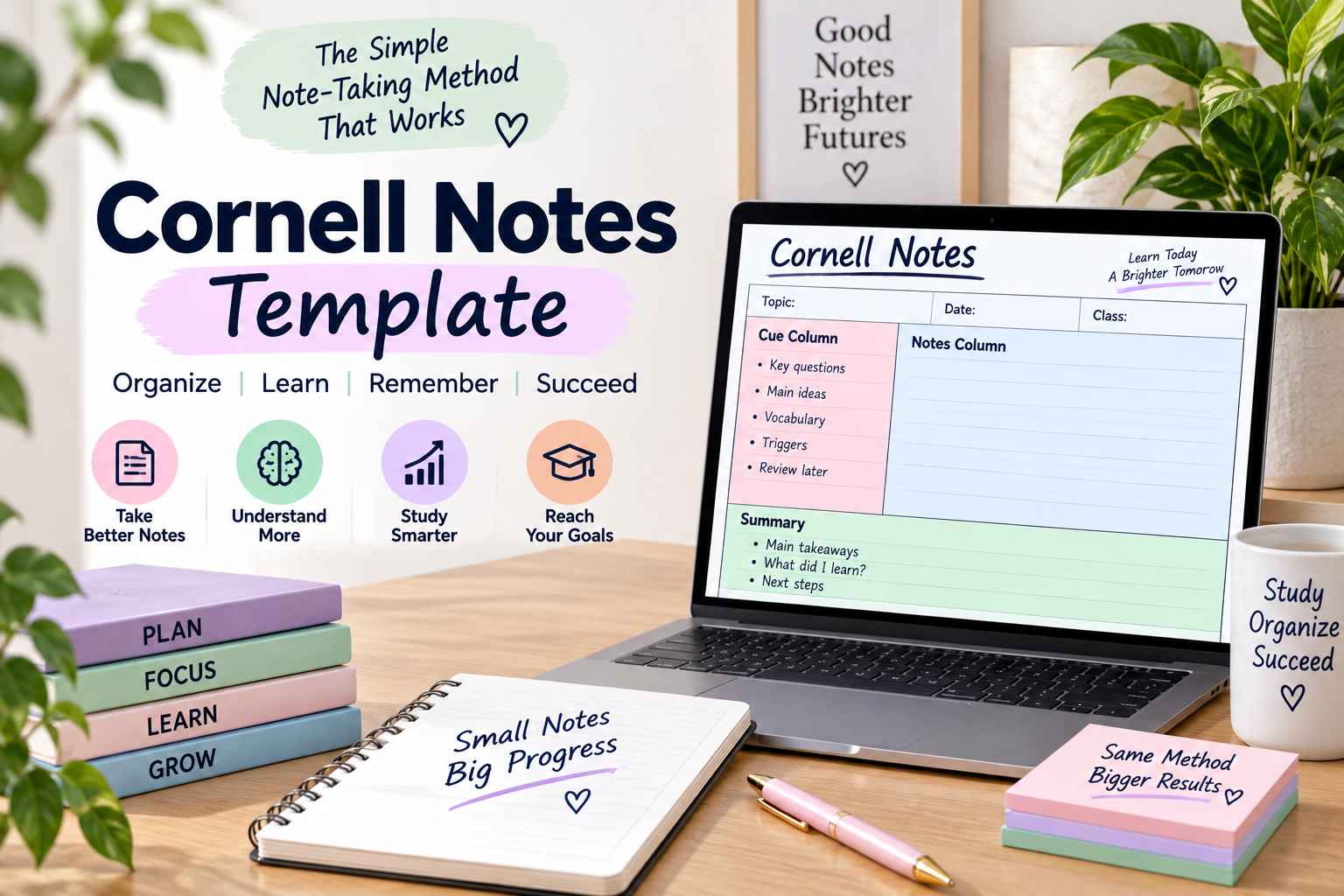
No, active recall studying is not an alternative to good notes, it works with them. You need good notes to refer to when you are regressing over the material to check your answers, and a Cornell notes style organization allows this to work out nicely.

Post Comment